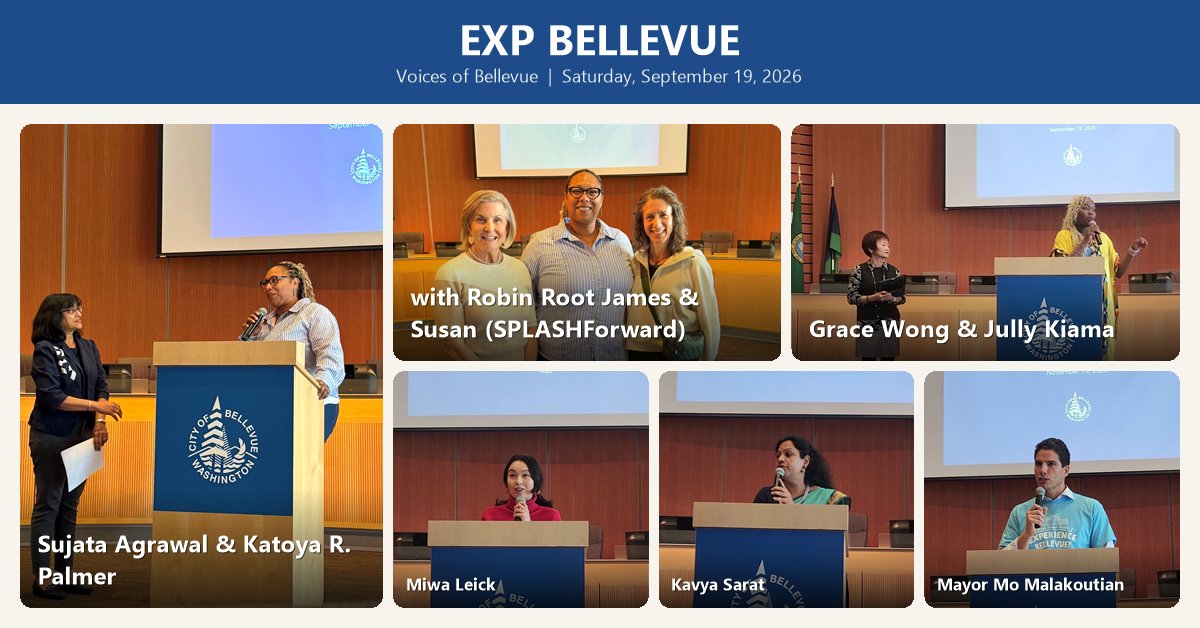
Voices of Bellevue, September 19, 2026. Everyone in these photographs made room for somebody.
I came to Bellevue after transferring my son to Eastside Academics. We moved during the pandemic. Our apartment is close to Bellevue College, which felt like the perfect location to me — he finished his associate degree there this summer, and he’s on his way to the University of Washington. So I’ll say it now: the move worked.
But when I first moved here, I had doubts.
I didn’t think Bellevue had room for more leaders, and I wasn’t sure how this community would welcome a personality like mine. Some of that was my culture and my gender. And some of it was money. I didn’t think I had enough resources to fit in here. Bellevue looks affluent, and I believed affluence was what got respected here. I thought people would see right through me.
More than that, this place looked finished to me. So well put together that I couldn’t see a gap for the kind of work I do. Community building. Business building. If everything works, how can I contribute?
Some of that was imposter syndrome — the feeling that you’re not supposed to be in the room. Some of it was true.
And the thing I thought I’d have to put away was myself.
That’s not new for me. In one room I was too much. In the next room I wasn’t enough. For a long time I didn’t know where I belonged. So when I got here, I assumed I’d do what I’d always done: decide which parts of me to bring, and which parts to mask. Truly, I didn’t think I could be open here.
Three rooms
SPLASHForward was the first board I joined here. Then Nancy invited me onto The Sophia Way. And Beth Osborne, who I met at The Sophia Way, invited me onto the Bellevue Chamber board.
Three rooms. Each one opened by a person.
The Chamber is where my imposter syndrome was loudest. That room is some of the most prominent business and political figures in Bellevue. I was humbled by the invitation. Then I met the president, I started mingling, and I thought: do I really belong here? I am not affluent. I run a small business, not a corporate entity. My work is grassroots, and the politics here were different from what I had been accustomed to.
And the Chamber welcomed me anyway. Not tolerated. Embraced.
Somebody handed me a chair. Not a guest pass.
The moment everything changed was the first time I said something direct in a room in this city, and it was accepted. No follow-up questions. It was understood. That’s when I stopped masking here.
Finding my place took longer than the invitation did
I kept saying yes. But at SPLASHForward I watched for a while. I didn’t find my footing until I had real responsibility, and that came this year, as Interim Treasurer.
At The Sophia Way I have served in several interim roles. I love that mission and I love that staff. And I have always felt welcomed there the same way we welcome the women who come to our shelters.
Interim, over and over. Somewhere in there I stopped wondering whether I had anything to contribute to this community. I knew exactly what I had.
And in the middle of all of that, I rebuilt my own company. Just over a year ago, almost to the day, I rebranded ToyBox Consulting and Management and started building again. And this city received it. From the moment I set out and started networking, Bellevue supported me.
My first chance to lead here came through the City’s Affordable Housing Strategy, as a community facilitator. We were chosen because the department and their consultants recognized the networks we already had. That work is where I started learning how funding moves in this city. And that is how I found the Cross-Cultural Center without Walls.
Then last November, the City held an open house for its Diversity Advantage Plan. They called it Building Belonging. I already had the grant in hand, and I sat in that room while this city committed, out loud and in public, to everyone here being able to thrive. The Council adopted the plan that December.
Just short of a year ago, I applied for the grant that became Golden Hour Unboxed. Fast forward a year, and here we are.
And Beth wasn’t done. When I set out to rebuild, she introduced me to Debbie Lacy at Eastside For All. Debbie became our nonprofit partner for Golden Hour Unboxed. She said yes, and it wasn’t a surprise. She had already been on my side that long.
Three boards, and each one feels like home in its own way — because I had to find my own way to belong inside each of them. None of it was for nothing. Not one of those rooms, not one of those connections. All of it was worth it.
And once people have made room for you three times, you stop counting yourself as new. That’s when I started noticing the people who still felt new.
So I built them a room
Golden Hour Unboxed. ToyBox produced it — an evening at the Bellevue Botanical Garden celebrating what the Black community contributes to the Eastside through entrepreneurship, art, food, storytelling and mentorship.
Honestly, I was nervous to bring it here. I had heard the comments: that people in Bellevue don’t want to spend money with us, that they don’t see the Black community out here, that Black initiatives don’t get supported. I did it in spite of all of that.
And what I was building, though I didn’t have the words for it then, was a room where nobody had to mask.
But an evening is only an evening. What makes it a welcome is what you decide before anyone walks in.
So: I did not charge the vendors. Not one dollar. When you’re a small business, the table fee is the thing that decides whether you come, and I wasn’t going to make anyone pay for the right to be seen.
One woman told me she arrived expecting to make almost nothing. She made several hundred dollars that day. Every vendor told me they would come back, and that next time they would even pay.
Three vendors signed up and couldn’t come. I wrote to them after the event to tell them they were missed. All three wrote back, and all three asked about next year.
That’s the part I want you to hear. You don’t only welcome the people who show up.
That’s the welcome I was given, and that’s what I handed someone else.
If you’re where I was
Somebody here is already willing to make room for you.
You may not recognize them when you meet them. It may not feel like a big moment, but it will feel like a chair being pushed out at a table you weren’t sure you were allowed to sit at.
Every room I’m in now, I almost didn’t bother entering.
So say yes to the small thing. The committee. The table. The meeting on a Tuesday night, in a building you’ve never been in. And when you get there, don’t do what I did, and spend your first year or two deciding which parts of you to leave in the car.
Bring all of it. The people who are ready to make room for you can’t do it until they can see you.