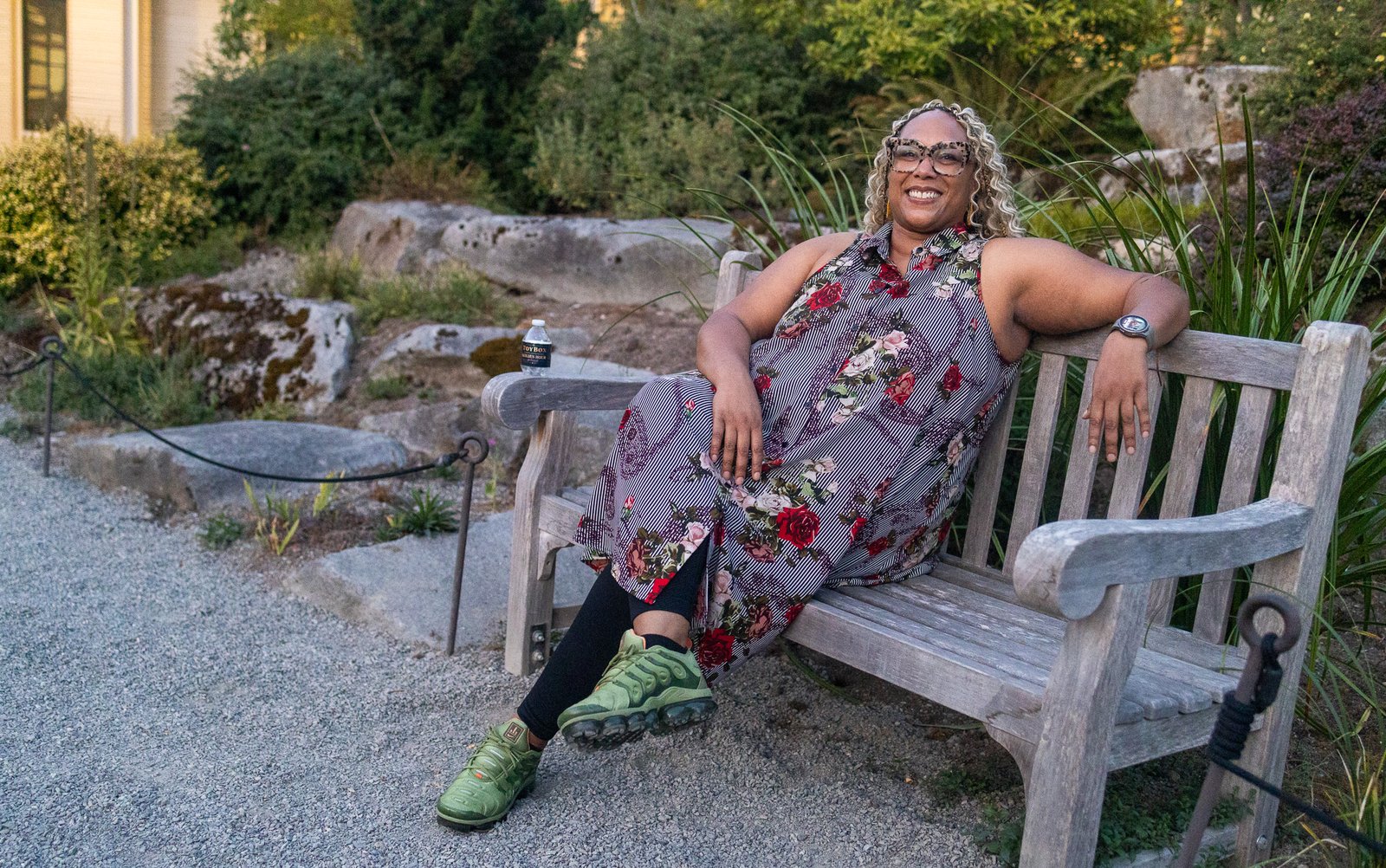
Before I organized anything, I sat down with a Black community leader here and told her what I wanted to do. She looked straight into the camera and said: they don’t want to spend their money out there. Have you called so-and-so? They’ve tried this already.
I have heard versions of that for years. They don’t recognize the Black community out there.
No is my favorite thing to hear. It is my favorite thing to hear because I am here. I serve on boards here. I am building a business here. My son went to school here. I have watched how well I have been welcomed in the rooms I walk into, and I wanted to hand that to somebody else.
So on August 23 we put our print in the sand, in a botanical garden in Bellevue, during Black Business Month.
What emerged fast was that people did not feel priced out of Bellevue. They felt they had not been invited. That is a different problem, and it has a different fix.
The decision that shaped the budget
The vendors did not pay to be there. No vendor fees. I used the grant to cover the permits, the licensing and the venue, so that the people I was inviting into a new market did not have to buy their way into it.
That was not a gesture. You cannot tell someone a market is open to them and then hand them an invoice at the edge of it.
Which means the cost of the evening had to sit somewhere other than on the businesses I was trying to lift.
A contract is not a grant, and it is not a sponsorship
Golden Hour Unboxed began with a production contract. The Cross-Cultural Center without Walls contracted ToyBox to produce the evening.
That distinction matters more than it sounds. A grant is money given to pursue a mission. A sponsorship is money given for visibility. A production contract is a purchase — someone is buying a finished event, and the producer has to deliver it.
It paid the venue, the permits, the licensing, the logistics. It was also the whole budget.
The permits are the barrier nobody writes down
I am a systems navigator. That is most of what I do for a living. So I want to be specific about what almost stopped this.
The special events permit. The sound permit. A health department that went back and forth on whether we needed a permit at all and eventually refunded one I had already paid. A headcount threshold I found out about the week before, which I met by counting my event planner and my emcee.
I could work all of that. I know who to call. But an emerging leader without that knowledge does not finish.
This is the actual work of supporting small makers: what kind of spaces can we provide that lower those barriers to entry? And when we build them, use the right word. I do not call it an exception. I call it an accommodation. We need accommodations because we are not as resourced as most of Bellevue. That is not a favor. That is arithmetic.
What filled the gap
Everything the contract did not cover arrived as donated or below-rate professional work.
Symetra backed the night as title sponsor, through Eastside For All, our 501©(3) nonprofit partner. That routing is not a technicality — a corporate community-investment line cannot reach a for-profit producer without it. Converge Media made the video and every photograph, and carried the outreach. Primo’s Bellevue served dim sum style, a cross-cultural exchange inside a Black Business Month event, and then donated the labor of it. The Madden Collective ran the floor, because producing a night and running a night are two jobs. A marketing partner, a venue that behaved like a collaborator, an anonymous donor for the decor, a poet who wrote a piece for that one room, and nine volunteers from load-in to teardown in the dark.
Two organizations gave no money at all. The Bellevue Chamber of Commerce (I serve on their board) and the Bellevue Downtown Association put us in front of audiences we had no other way to reach. For a first-year event, that is the difference between a night your community knows about and an empty garden. Count reach as funding. It behaves like funding.
Did it work
Not by how many people came. By whether a market actually happened.
One vendor was new. She told me she had not expected to make more than a couple of bucks, especially at an event where she had not paid to be there. She made several hundred dollars that day.
And every vendor said they would come back — even if they had to pay a fee next time.
That is the number that matters. A market is not a building and it is not an evening. It is a habit: people who know each other well enough to buy from each other, often enough that it holds. Vendors willing to pay in year two means year one was not charity. It was a market.
Charmaine Madden, who ran the floor, put the on-ramp better than I can: “You have an opportunity to get past those initial jitters when you do something like a festival or a market — when you get to have those intimate conversations with people about what you do and who you are.”
Two complaints, for the record. Not enough chicken and waffles. And people wanted a wine garden.
This is not happening in isolation
In the last three weeks, three bodies were stood up in this state to ask a version of the same question. Governor Ferguson’s Economic Development Council convened 21 August — Washington’s first dedicated economic development body in twenty years, twenty-six members across business, labor, education and tribal leadership. On 9 September, Seattle Mayor Katie Wilson signed an executive order creating the Resilient Seattle Economy Task Force. On 14 September, Challenge Seattle launched the Partnership for a Competitive Puget Sound — roughly fifty elected officials across four counties, seated with labor and business behind a twenty-point plan. Former Governor Chris Gregoire: “We cannot resort to relying on yesterday’s success while tomorrow’s jobs go somewhere else.”
Closer to home, Bellevue’s 2026–2031 Economic Development Plan, adopted in April, commits to inclusive growth — “strategically invest in services and systems that support residents, entrepreneurs, workers and learners from historically marginalized communities.”
Look at who sits on those bodies. Business and labor. Four counties. Twenty mayors and a dozen legislators who agree with each other about very little. Nobody convenes a group like that because it is comfortable. They do it because an economy is infrastructure, and infrastructure does not belong to a party.
Golden Hour is small next to any of those numbers, and it is the same category of work at a layer they cannot reach. A twenty-point regional plan does not put a candlemaker and a customer in front of each other, and it does not tell a new vendor the permit is already paid.
What this model can and cannot do
Every organization on that list said yes before there was evidence the event would work. I know what that is worth. It is also a model that works exactly once.
The photographer who donated thirty frames to a launch needs paying in year two. The caterer who sponsored his labor did it to help something begin, not to subsidize it indefinitely. Nine volunteers cannot be the permanent operations plan.
A market needs tending. Year one, the tending was done by people who decided it should exist before anybody could prove it would. Year two is about closing the distance between what it costs and what it is funded to cost.
If you are building something like this
Find a fiscal sponsor before you find a sponsor. A 501©(3) relationship unlocks money that cannot otherwise reach you.
Know the difference between a contract, a grant, and a sponsorship before you walk in, because the person across the table does.
Ask for the specific thing. Not “can you help” — “donate your labor and I will cover food cost.”
Price the barrier, not just the event. Permits and fees decide who can show up at all. Pay them first.
They said people would not spend their money out here.
They spent it. Every vendor said they would come back, and would pay for the privilege next time.
That is worth putting on the record.
Golden Hour Unboxed took place August 23 at the Bellevue Botanical Garden, presented by ToyBox Consulting & Management as part of the City of Bellevue’s Cross-Cultural Center without Walls. The full record is at goldenhourunboxed.com.