Prologue: The Story Before the Story
Around the holidays, people talk about who they’re “leaving behind” next year. And recently, I’ve watched a rise in influencers framing poverty as a mindset problem—as if discipline and desire are the only missing ingredients.
They say people are poor because they “act poor.”
They say wealth is a language you can simply learn.
They say those who struggle are “outing themselves.”
But every time I hear those messages, a quiet part of me says:
You haven’t seen enough.
Not anger.
Not resentment.
Just truth.
Because beneath the surface of these clean, clickable narratives, real people are carrying histories, systems, and barriers that no vision board or mindset workbook can undo. And some of us who grew up inside those realities now sit beside you in boardrooms, community meetings, airports, and gyms—moving quietly, reading the room, translating worlds, holding stories you never imagined belonged to us.
People like me.
The Quiet Thread.
The one woven through rooms you never thought to look at closely watching, listening, remembering.
Present, unnoticed, necessary.
This isn’t the old moral tale you were raised on—this haunting belongs to an age where lessons arrive through screens, edits, and perfectly framed moments.
To understand the story fully, you have to walk through it.
So tonight, three ghosts—and one final truth—arrive to guide you.
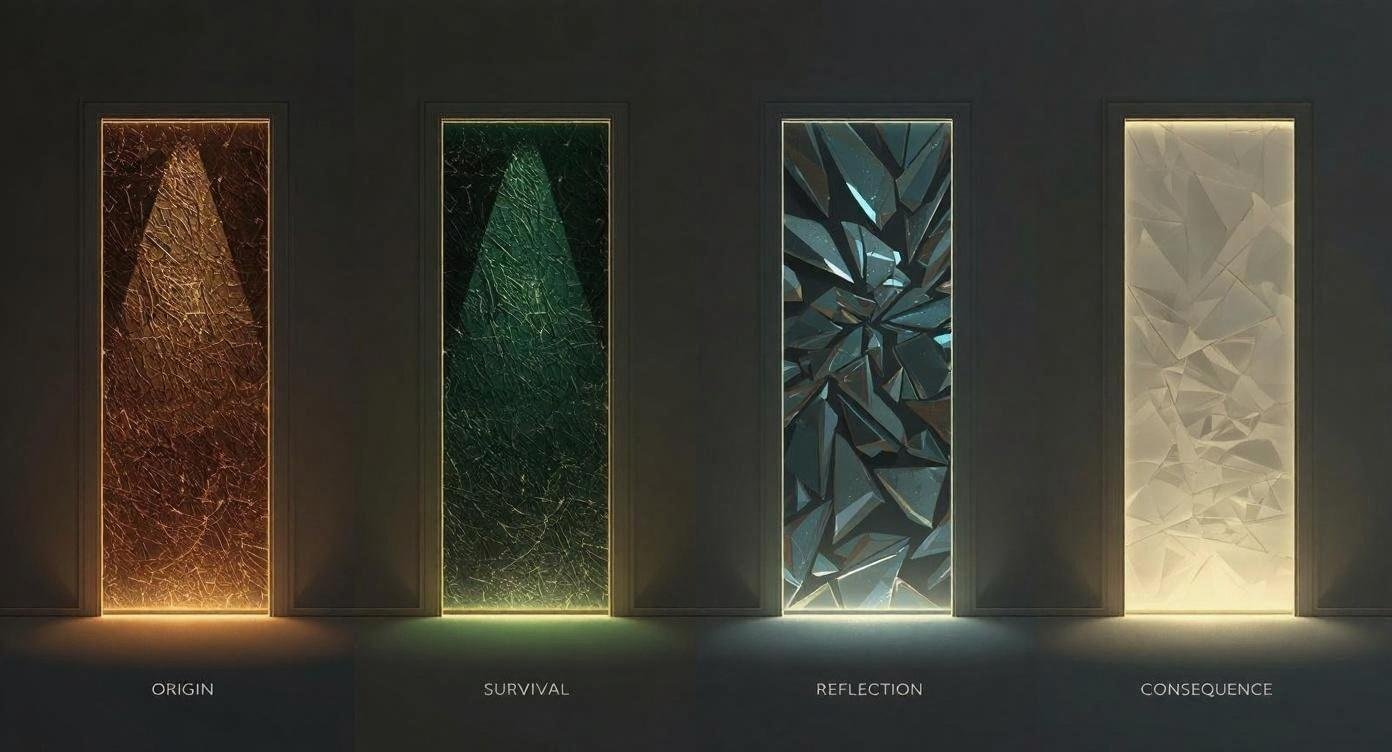
I. The Ghost of Origins
“Look at the soil before you judge the seed.”
The Ghost of Origins enters like a filter shift, soft, seamless, a transition you don’t feel until the world rearranges itself. Draped in bronze velvet with a pecan shell pinned at the shoulder, he carries the presence of a warrior king. His voice arrives before he does, low, resonant, a vibration more than a sound. The hum of cicadas signals where we’ve arrived.
A swipe of his hand, and the earth turns red beneath your feet.
Packed. Warm. Heavy.
A Southern town following unwritten rules long after the laws changed.
Segregation hasn’t been outlawed here so much as redirected—into zoning maps, grocery store placements, school boundaries, and which side of town received paved roads first. Old patterns survived because they were never uprooted.
The ghost studies the influencer with a knowing smirk.
Look closely. The past is not as distant as you think.
Swipe:
A little girl running barefoot across red earth becomes a child watching her mother rush toward a bus with college textbooks pressed tight. No applause. No shortcuts. A woman stretching possibility inside borders not meant to expand.
The ghost pauses.
He cracks open a fresh pecan—shell crunching, meat collapsing softly. He eats slowly, deliberately, watching the influencer absorb what ambition actually costs when the soil is stacked against you.
Swipe.
The mother working in environments where rules bend for some but snap back for others. Racism not subtle. Sexism not hidden.
She leaves. Not for opportunity, but for survival.
She sells everything she owns to make a new start.
Swipe.
The daughter grows—hair pressed smooth, handmade dress, academic accolades, glowing potential. But young adulthood narrows the path. Supports fall away. Harm slips in. Poverty doesn’t arrive because she lacked discipline, it arrives because the ground was uneven long before she stepped onto it.
The influencer folds their arms, irritated as though the ghost is interrupting a narrative they’d worked hard to sell.
Then the ghost finally speaks:
“Before you decide someone is choosing hardship, learn the history of the soil beneath their feet.”
The scene folds away like a closing app.
Some stories don’t begin with lack of discipline.
They begin with landscapes shaped to hold certain people in place.
He gestures forward.
There is more to see.
II. The Ghost of Survival
“Watch what survival actually looks like.”
The Ghost of Survival glides in like the next recommended video, smooth, predictive, inevitable. Draped in emerald velvet with gold trim, wearing jewelry that catches the light with every movement, this ghost carries the energy of a quirky, chubby, clumsy-but-precise old soul—one chosen by ancestors, wise beyond their years.
In their hand: a plate of peppermint bark.
They never eat it.
They break it—each snap a soft punctuation mark.
Snap.
A hospital room:
A young mother leaning over a premature infant, recalculating her entire future in a single breath.
Snap.
A modest apartment—papers stacked, bills due, Section 8 voucher clipped to the refrigerator.
This is not a moral failing.
It is survival.
Snap.
Work. More work. Invisible work.
She studies after midnight.
She graduates with her son watching proudly.
Snap:
Boardrooms.
Civic meetings.
Policy discussions.
Galas where she blends in seamlessly because people confuse fluency with privilege.
This is a world where scarcity becomes spectacle, where those struggling must perform resilience for an audience that mistakes survival for choice.
The ghost moves, bracelets clinking softly with each step—clumsy, intentional, guided and guiding at once.
Dismissive and irritated, the influencer rolls their eyes. Yet something in the woman’s exhaustion lands deeper than they expect.
The ghost stops.
Snap.
“You confuse survival with insufficiency,” they say.
“You confuse proximity with privilege.
“You confuse endurance with ease.”
The influencer looks again—really looks—at the layers this woman carries, the worlds she translates, the cost of every step.
The ghost leans forward.
“Having less never meant understanding less.
And rebuilding is not the same as failing.”
Peppermint crumbs scatter.
The atmosphere shifts.
There is one more conflict to face.
III. The Ghost of Reflection
“See the truths you don’t want to name.”
The next ghost arrives like a dimming filter, a shift in contrast, an emotional temperature drop you feel before you see her. Feminine. Elegant. Severe in beauty. She wears a gown of shifting blues and silvers, embedded with mirrored accents that fracture the world around her with every step. Her hair is laid to perfection, face beat, nails long and gem-encrusted—each one a reflective truth waiting to be tapped.
In one hand: a coupe glass of amber aperitif.
Untouched.
Raised like a mirror the influencer is afraid to look into.
Swipe—nails slicing the air.
Influencers appear, dispensing simplified advice from polished rooms:
“Act rich.”
“Speak wealth.”
“Leave the poor behind.”
“Discipline is the difference.”
“You sell these narratives,” she says,
“not by accident, but by design.
“Because they perform.”
A tap of her nail—tink—delicate, precise.
Swipe.
Comment sections appear:
People pleading for wages, housing, transportation, safety.
“In every society,” she murmurs,
“there comes a point where repeated stories quietly and unquestioned harden into rules until people forget they ever had a choice.”
Swipe.
Internal conflicts within communities shaped by scarcity:
“Don’t act brand new.”
“You think your better?”
“You haven’t struggled enough.”
Scarcity becomes culture.
Identity becomes containment.
Ambition becomes threat.
She pauses—not for drama, but for accuracy.
The mirrors on her gown refract the room into a thousand truths.
“And even in the worlds built for women—
where elegance is taught as escape,
where desirability is sold as strategy,
where partnership is framed as procurement—
so much of the guidance still tells women that safety is something they must perform.”
A beat.
“These are not fairy tales,” she continues.
“They are systems.
And systems do not shift because a woman perfects her script.”
For the first time, the influencer’s expression cracks, pride bending under the weight of recognition.
She steps closer.
“Not owning something is not the same as not understanding it.
It simply means you weren’t born near it.”
Another swipe—mirrored light dancing across the walls.
“You tell people to level up,” she says quietly,
“but you’ve never climbed with weights on your ankles.”
She turns.
One last truth remains.
IV. The Ghost of Consequence
“This is the world shaped by your narrative—and by your profit.”
The final ghost arrives in a wash of soft white light—
androgynous, statuesque, serene.
Skin like moonstone catching gentle luminescence.
Hair luminous pale gold.
Clothing white and architectural
Everything is precise.
In their hand: one glowing ornament.
They tilt it.
The future scrolls.
Young people internalizing shame as identity.
Parents believing structural failures reflect personal ones.
Communities fracturing into deserving and undeserving.
Policies shaped by social media philosophies rather than data.
A future where the arena isn’t physical, but digital—
where narratives are the battleground
and perception is the prize.
The ghost watches the influencer without judgment.
“You created these narratives with intent,” they say.
“For engagement. For profit. For identity.
And the world they shape is larger than you planned to see.”
Tilt.
Perception becomes belief.
Belief becomes culture.
Culture becomes system.
“Plant what you preach,” the ghost says.
“And preaching becomes culture.”
The ornament brightens.
“Mindset is powerful.
But mindset cannot replace infrastructure.
It cannot replace access.
It cannot replace safety.
It cannot replace generational stability.
And it cannot rewrite structures created long before you were born.”
A final shift reveals The Quiet Thread—
the woman whose life has been stitched into every lesson.
Someone the influencer has walked past in airports, sat beside in meetings, stood near in lines, shared rooms with—never realizing the complexity she carried.
“This,” the ghost says,
“is the person your narratives flatten.”
The ghost dissolves.
Only The Quiet Thread remains—steady, layered, human.
Behind her, the influencer stands, not victorious, not undone, but unsettled.
Haunted.
Humbled.
Unsure what to do next.
Epilogue: What the Thread Reveals
Some of us learned to translate between worlds.
Some of us survived on unstable ground.
Some of us succeeded despite maps that pushed against us.
Some of us rebuilt from zero more times than anyone will ever know.
You may not recognize us,
but we have always been here.
And when you talk about poverty as personality,
you are talking about us.
The thread is not a warning.
It is a record.
A reminder.
If you want to speak about poverty,
learn the soil.
Learn the systems.
Learn the cost.
If you want to teach wealth,
learn the histories of the people in the room with you.
And if you want to build a better world,
start by understanding the ones your words are already shaping.
AUTHOR’S NOTE
This piece came together from two things I love: holiday stories like A Christmas Carol, movies like Scrooged, and the ghostly, haunting mood of Halloween. I’ve spent this past year watching influencer culture talk about “leveling up” in ways that flatten real people’s experiences. And because I’ve lived in and around those realities such as instability, rebuilding, leadership rooms, and everything between I felt a pull to explore that tension. This essay is part social mirror, part seasonal storytelling, part love letter to the people who carry complex histories in silence. The Quiet Thread is an archetype shaped from that world: visible and invisible at once, moving through rooms others assume they understand.